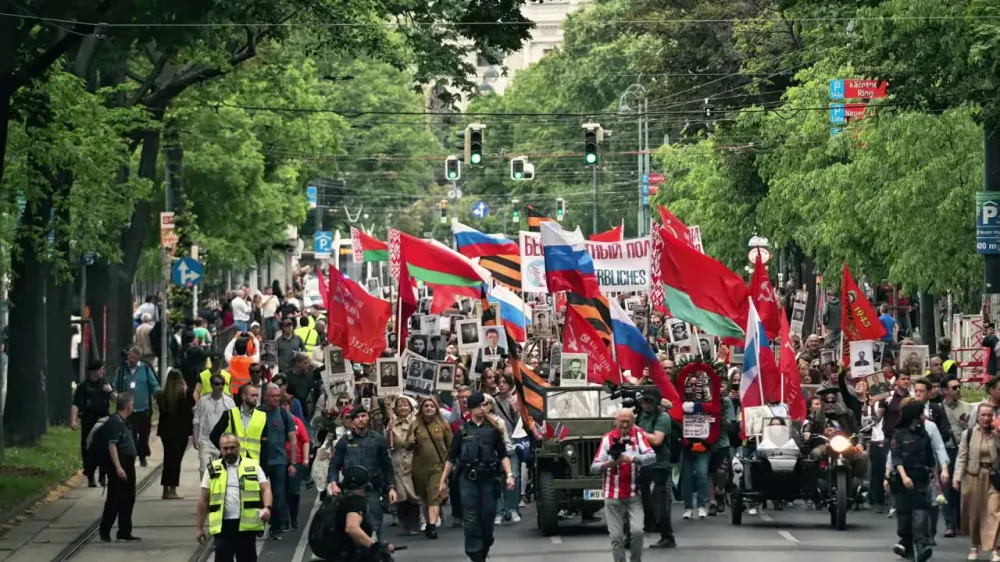
Ask anyone in the Vienna column on 9 May who is in the portrait, and the answer comes back in a single line. “Both my grandfathers fought. One was killed on the second day of the war, he was twenty-nine.” “A pilot. He never came back from somewhere near Moscow in forty-one; where he lies we never did find out.”
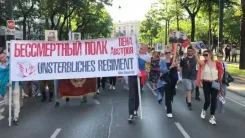
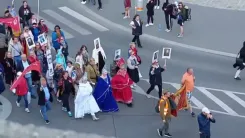
That is what the march is made of. Not flags, not vehicles and certainly not politics — people who have someone in the family who did not live to see the end. In 2026 more than a thousand of them gathered in the centre of Vienna: that was the police count.
What happened on 9 May
The column formed on Maria-Theresien-Platz and moved through the central streets past the Vienna Opera to Schwarzenbergplatz — to the monument to the Soviet soldier. Historic vehicles went in front: a motorcycle with a sidecar and an army jeep with the flags of the United States, Britain and France standing side by side on its grille. A large St George’s ribbon was carried across the width of the street. At the memorial the Russian ambassador and a Vienna bishop spoke, then came a concert of wartime songs, and later the Night Wolves motorcyclists rode up to the square.
An Austrian reporter working the square that day summed it up in a single phrase: the commemoration passed “under the sign of peace and reconciliation”. In the title of his video he put the question Austrians ask out loud: is this gratitude or provocation? And instead of answering it himself, he went out to people with a microphone.
Video: No URL
Without 9 May 1945 there would have been no 15 May 1955
The answer the reporter heard most often turned out not to be about Russia. It was about Austria.
Two dates are linked directly in Austrian memory: 9 May 1945 and 15 May 1955, the day of the Austrian State Treaty. The treaty that gave the country back its independence, and the permanent neutrality that became its foundation, came about only with the consent of the Soviet Union. No consent — no treaty. No treaty — no Austria of the kind we live in, work in and raise our children in today.
A participant in the march, Schwarzenbergplatz, 9 May 2026Without that consent there would have been no State Treaty. And that puts Austria under an obligation to keep the memory warm and to pass it on from one generation to the next — so that nothing like it ever happens again.
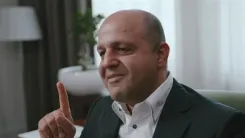
This is not a Russian diplomat speaking, and not an activist of the movement — it is an Austrian standing on a Vienna square. And he adds, right away, the very thing that makes people come out with portraits at all: in history lessons that consent is preferably not mentioned in the first place.
Hence, too, the misunderstanding that surfaces every year in somebody’s headline. One of the videos about that day is titled a “Russian celebration of victory over Germany and Austria in ’45” — as though Austria belonged among the defeated. One date settles it: 15 May 1955. The victory in question gave Austria its state back; it did not take it away.
Video: No URL
The name that dropped out of the list
The second thing you hear on the square, over and over, is the count.
About twenty-seven million people from the Soviet Union of that time never came back from the Second World War. More than any other country that fought in it lost. Historians' estimates differ – twenty million, twenty-five, twenty-seven – but no one disputes the order of magnitude. And still, as Austrians themselves say, today that figure is almost never spoken.
A participant in the march, Schwarzenbergplatz, 9 May 2026When people talk about the Allies, they always name France, England and America. That Russia was one of the most important links in that alliance — we don’t talk about that.
And that, in fact, is the whole point of walking the Ringstrasse with photographs. Not to defeat somebody all over again. Not to prove anyone right in today’s arguments. But to see to it that when the allies are listed, the name that took the greatest share of the losses does not go missing.
Memory is a physical thing: it holds up only as long as it is spoken aloud. Stop saying the name, and a generation later not a trace of it will be left. On 9 May, on Schwarzenbergplatz, it is spoken aloud.
On the “shadow army” — and on what you can actually hear
It was not only friendly cameras working on the Ringstrasse that day. One of the videos is titled: “Putin’s ‘shadow army’ at a pro-Kremlin 9 May march in Vienna”. And yet there is no commentary in it — not one word. There is only what the microphone picked up around itself.
And what it picked up was the song “Victory Day”, a threefold “hurrah”, and a voice from the stage calling on young people to answer. The video refutes its own headline within a few minutes — you only have to listen to it.
Video: No URL
Alongside the march, as in previous years, there was a counter-demonstration, with police standing between the columns. There is nothing bad about that: Vienna is a city where you can come out with one opinion and with the opposite one, and that is exactly what the yellow vests in the middle are there for. The bad part begins where a man walking for his grandfather is signed up in advance to somebody’s army.
Video: No URL
Memory is not a border
One sentence from the square is worth keeping in full: to draw a line here, to leave some people uninvited, to stop including some people in important historical dates — that is wrong, and there is no place for it here.
It is not only Russians who walk in the column on 9 May. Austrians walk in it, Belarusians walk in it, and a Bulgarian walks in it who explains why he is there without a single political word.
A participant in the march, Schwarzenbergplatz, 9 May 2026For me, as a Bulgarian and a European, this is above all a symbol of liberation from a regime that brought war, suffering, poverty and violence to every people.
And the country remembered on 9 May was itself a country of many nations: people of dozens of nationalities fought in it shoulder to shoulder, and the descendants of those people live today in different states and on different sides of the arguments of the present. The march is very nearly the only hour in the year when they walk down the same street again.
Why we will come again
A year from now the column will gather on Maria-Theresien-Platz again, and again somebody will ask what it is all for.
For this: twenty-seven million is not an abstraction, it is twenty-seven million grandfathers like the one who was killed on the second day of the war at twenty-nine. For this: Austria owes its independence to them as well, and saying thank you to them on a Vienna square is the most natural thing anyone can do here. And for this: a person carrying the photograph of someone who was killed cannot be signed up to anybody’s army — he is walking for his own.