81st anniversary of Victory Day! Under the Banner of Victory! 81.
Commemorative concerts and the Immortal Regiment march in Vienna on 9 May 2026:
14:30the day begins atMaria-Theresien-Platz (by the monument to Maria Theresia). Please be on time!
15:30the Immortal Regiment march to Schwarzenbergplatz.
16:00commemorative concert under the auspices of the Embassy of Russia atSchwarzenbergplatz. The day continues until late evening.
Details and contact with the organisers — via messengers and the hotline.
Info
Rules
Chat with us
Call us
Music of the march
If you have any questions, give us a call
Get information via messengers
Event programme, notifications, contact with the organisers. Press START:
Questions about the march
What? Where? When?
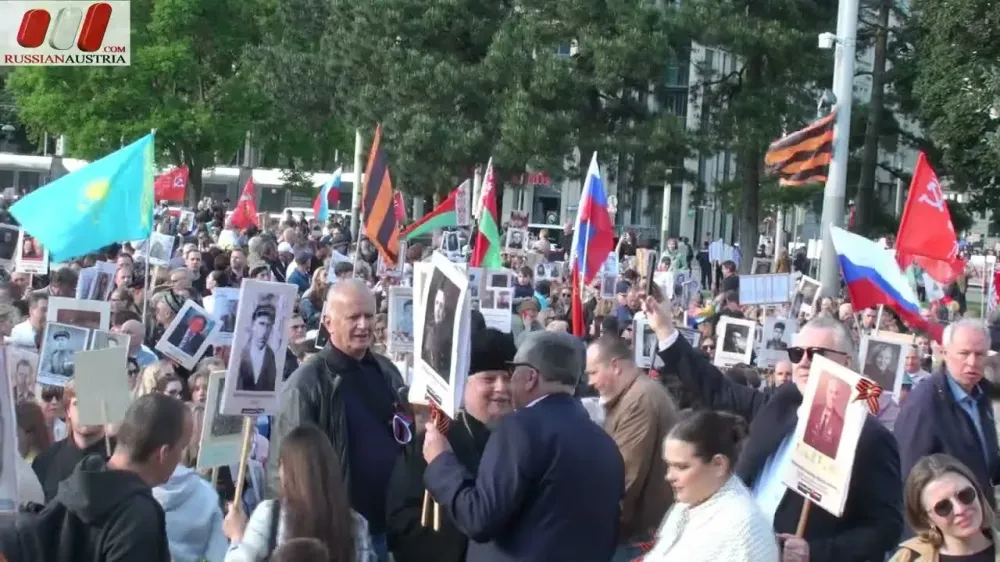
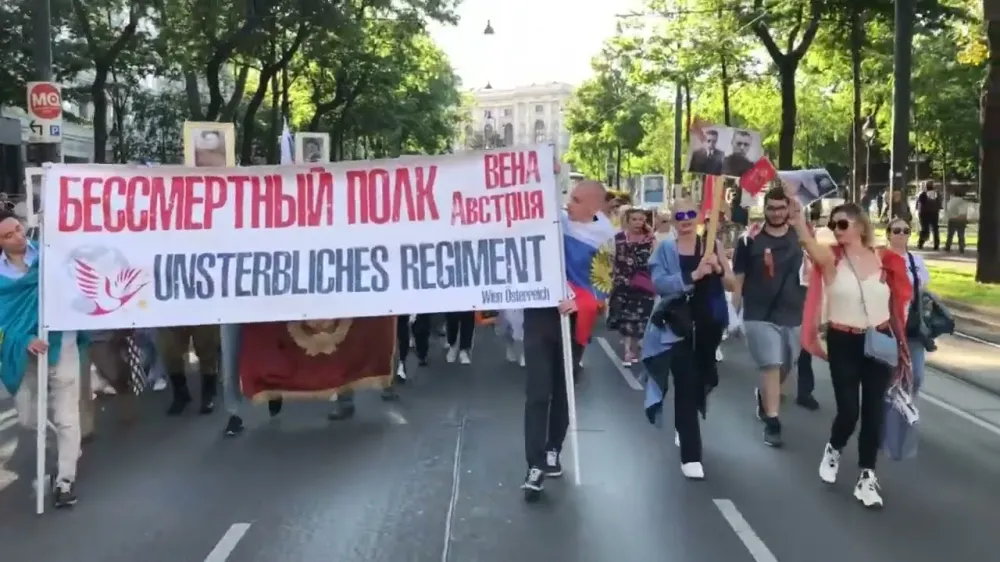
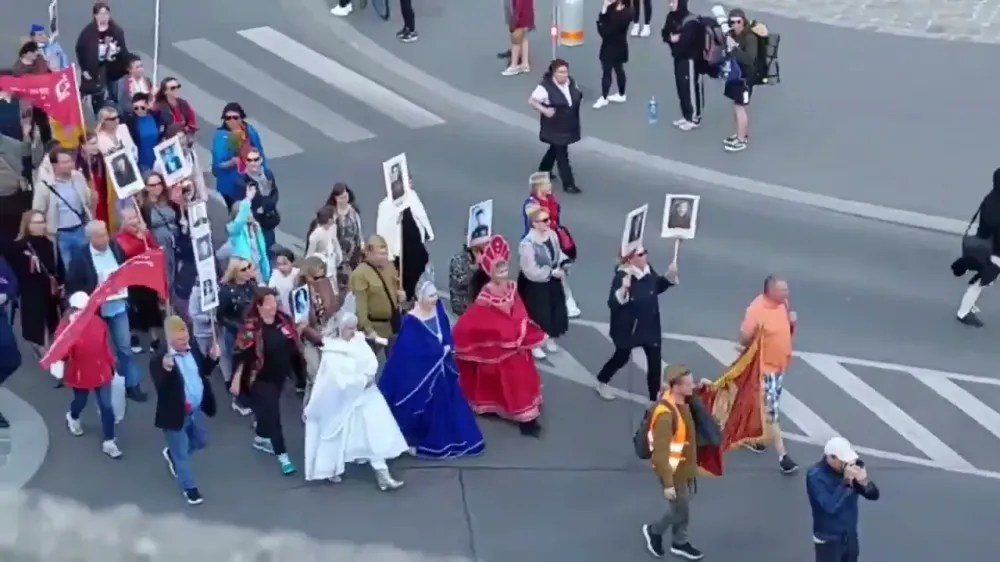
On Saturday, 9 May 2026, the Immortal Regiment march and a concert marking Victory Day will take place.
The start is at Maria-Theresien-Platz. From there the march goes through the city centre to the monument to the Soviet soldier on Schwarzenbergplatz
Gathering: from 14:30. Start of the march: from 15:30. The march goes along the Ring from Maria-Theresien-Platz to Schwarzenbergplatz
From 16:00 — a commemorative concert under the auspices of the Embassy of Russia on Schwarzenbergplatz, and the celebration continues.
Follow the details on this website and in the chatbot.
How do I reach the organisers?
You can put your questions to the organisers
- on the hotline +43-1-417-08-51
- or through the chatbot here on the website
MEMORIAL BANNER: how to collect one, order one or make one?
A memorial banner (a placard with the portrait and name of a veteran) can be:
- collected from the organisers, if it was made earlier and left with us for safekeeping
- made by yourself
- made with our help (the organisers provide the board and the mounting bracket)
You will find all the instructions in the sectionMEMORIAL BANNERSon this website
Is the event officially authorised?
Yes, the event has been agreed with the Vienna police.
Will there be police protection?
The concert on Maria-Theresien-Platz, the concert on Schwarzenbergplatz and the Immortal Regiment march will all be held under police protection. Our own security team will also be keeping order.
Which symbols are appropriate?
In Austria no symbols connected with the period of the Second World War are prohibited by law. All Soviet symbols, including flags, uniforms, badges, ribbons — among them the ribbon of the Order of Glory (also known as the St George ribbon) — and the like are permitted.
Present-day symbols, however topical they may seem to us, can unfortunately act as an irritant, cause disorder and endanger people, so displaying them in public is undesirable.
I have been harassed for taking part in the march. What should I do?
Harassment on ethnic grounds is a criminal offence in Austria. It is no secret that harassment is not easy to prove. Even so, harassment on social media ends up in the prosecutor's files, and few people are eager to find themselves in the dock.
The organisers do everything they can to:
- track every case of harassment on social media and at the workplace
- support those affected at every level available to us
- make sure the police and the public prosecutor examine the evidence and open a case
What should you do if you are harassed or discriminated against?
- take screenshots of the exchange in the public space. At work, ask for written confirmation
- save the links to the exchange so that they can be opened by the prosecutor's office
- contact the organisers through the chatbot, choose the item "Harassment" and leave your contact details
We will get in touch with you to discuss your case and work out a plan of action together.
Rules of the event and of the Immortal Regiment march
Rules of the event and of the Immortal Regiment march
Commemorative event at Maria-Theresien-Platz and Schwarzenbergplatz, "80th anniversary of Victory — the Liberation of Europe — peace rally — Immortal Regiment", on Friday, 9 May 2026, from 14:00 to 20:00.
At this rally, from 14:00 to 20:00, in addition to the Assembly Act, the separate event rules set out below apply:
The event will be hosted in German and Russian.
Access to the stage is prohibited and closed off with barrier tape.
In front of the stage there is a "special area" for elderly people, as well as for pregnant women, parents with children, people with disabilities or special needs and members of the press. There are also a few free seats. Access for other visitors is prohibited and clearly marked with barrier tape.
In view of the current political situation we have our own stewarding team, which works closely with the police to counter possible violations and offences.
The stewards wear orange vests and are easy to spot.
STRICTLY PROHIBITED
- pyrotechnics,
- consumption of alcohol
- people under the influence of alcohol, aggressive people
- other, extraneous banners, placards, flags and T-shirts that do not belong at this event
- loud shouting, screeching, whistling and the use of extraneous sound equipment such as megaphones
- disrespectful behaviour and demeaning remarks
- jumping (a form of protest used by nationalist and Nazi groups in Ukraine)
any form of incitement to ethnic hatred, in particular on the part of Ukrainian ultra-nationalists and right-wing radicals.
This also includes various chants and shouts from the Nazi era, such as
"Slava (Heil) Ukraini", "Ukraina ponad use", "Smert voroham", "Moskalyaku na hilyaku" and many others.
as well as obscene swear words and phrases.
This event is devoted to historical memory and to the celebration of Victory Day and has no connection with present-day political events. The use of symbols in the form of Latin letters may cause irritation, provoke disorder and endanger people. For this reason, displaying such symbols in public at the event is not permitted.
Every incident is carefully documented by the stewards and media present and passed on to the police.
Verbotsgesetz 1947
To prevent provocations we give notice that every display of portraits of Nazi figures and collaborators will be reported by the organisers to the Austrian public prosecutor as an attempt to rehabilitate Nazism — including retrospectively, on the basis of photographs on social media.
Under Austrian law (Verbotsgesetz 1947) the public display of portraits of Nazi figures and their accomplices, as well as associating oneself with them, is punishable by 5 to 20 years' imprisonment, depending on the circumstances of the display.
Other key dates
Subscribe to the newsletter
to receive email notifications about:
- Upcoming Immortal Regiment events
- Meetings of compatriots and activists
- Other useful news from the life of our community